PSP Setup
A Seven-MID Payment Stack Built for High-Volume Growth
Company
Anvil Nutrition
Product
Supplements
Stage
Second Brand, High-Growth
Processor
Described structurally — not named
Problem
The merchant came to Compaytence with a footwear company processing roughly $300,000 to $400,000 a month through Shopify and selling into the United States. The setup was missing several elements required by traditional underwriters, including a U.S. signer, a physical U.S. business address, and an ITIN. Because Shopify Payments allows merchants to begin processing without a full underwriting review, those gaps had not yet prevented the business from accepting payments.
After the footwear business was set up properly, the merchant launched a supplement brand. Because supplements are considered high risk and the new brand had no processing history, getting approved by a third-party processor was difficult.
That left too much of the business dependent on a single account. If the Shopify relationship ended, the brand could lose both its ability to process new transactions and access to the stored card tokens needed to charge existing customers. Relying on one provider also limited how much volume the business could support.
Approach
We prepared the business for underwriting and built the payment infrastructure needed to support higher volume.
Prepared the websites for underwriting
We reviewed both websites and updated the compliance language, policies, and marketing claims that could raise concerns during underwriting. Because each processor has its own policies and risk thresholds, we prepared the business around the specific requirements of each provider.
Assembled the documentation
We secured the ITIN, physical U.S. business address, and authorized signers required by the providers. Since those requirements vary, we prepared a separate set of documents for each provider to reduce back-and-forth and keep the process moving.
Reduced reliance on Shopify Payments
As volume increased, processing was gradually shifted away from Shopify Payments. Compaytence sourced all seven MIDs the business now uses, distributing volume across multiple providers and reducing its dependence on any single account.
Moved stored payment data outside Shopify
The MIDs were connected through a third-party checkout, so stored card data was no longer tied exclusively to Shopify. If one processor became unavailable, transactions could be routed through another MID without losing access to existing customer payment data.
Built cascading and intelligent routing
If a transaction is declined by the primary processor, it can be retried through another MID in the portfolio. A payment router directs traffic based on processor availability and performance.
Solution
Around $4 million in monthly processing volume.
$106,000 processed in a single trading day.
Seven MIDs, all sourced by Compaytence.
By putting the infrastructure in place early, the merchant was able to launch and grow the supplement brand without relying on a single processor. The payment stack now supports higher volume, distributes risk across seven MIDs, and gives the business greater control over routing and stored payment data.
Proof
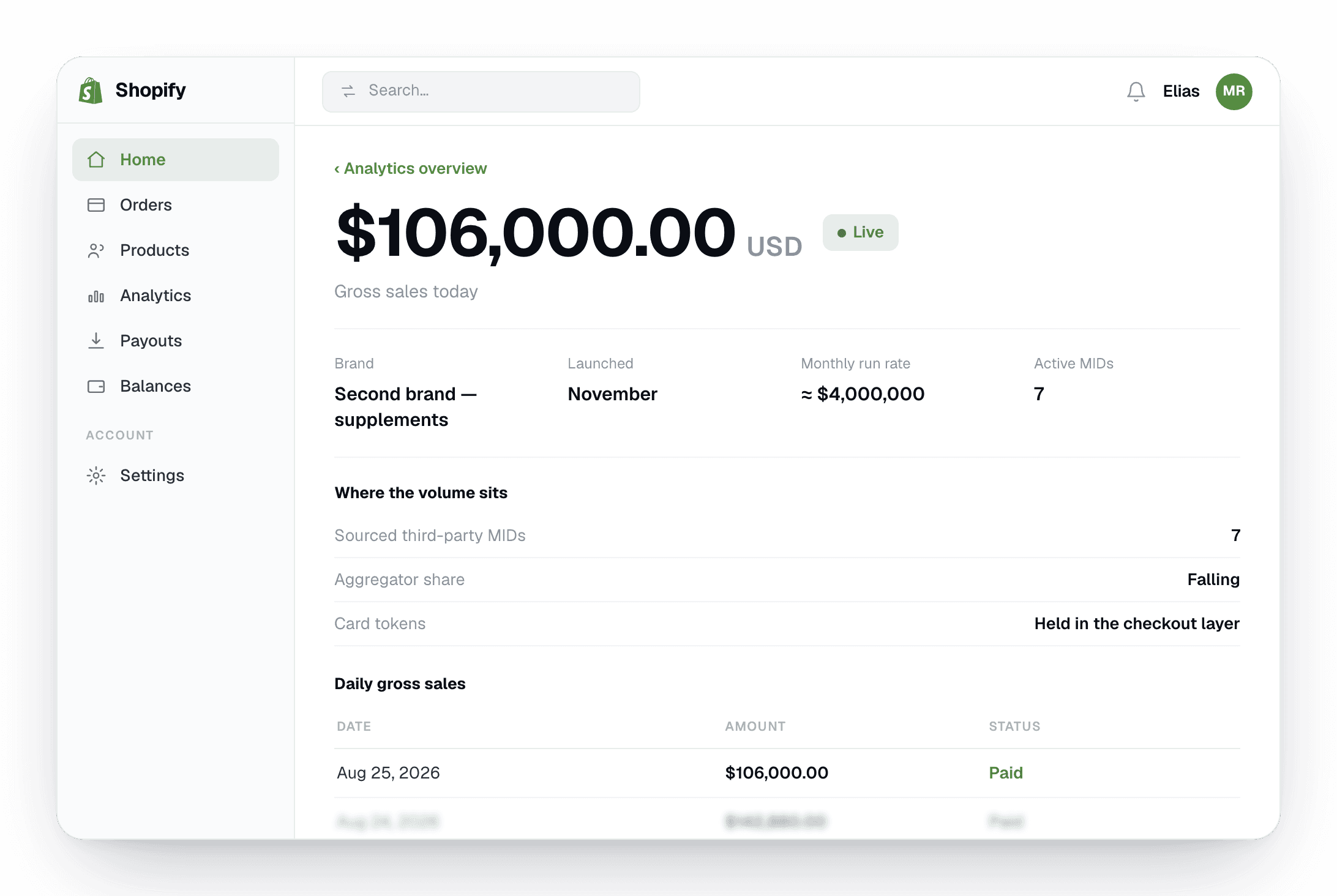
$106,000 in one day on the supplement brand

The seventh processing account goes live — no single-provider risk
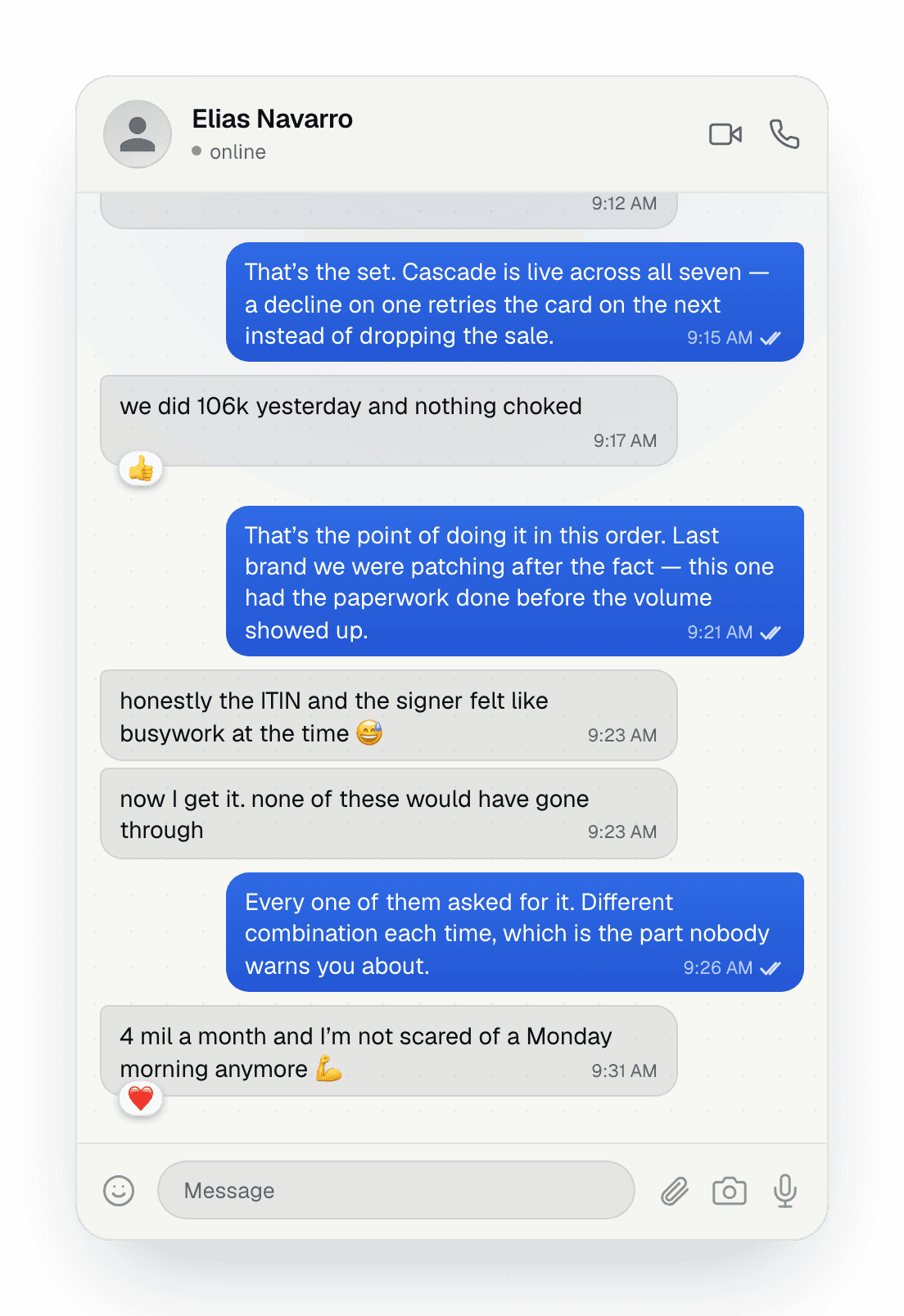
$4M a month running across seven accounts