
Every card-accepting business is assigned a Merchant Category Code (MCC), a four-digit code identifying the primary type of goods or services it provides. The classification system is based on ISO 18245 and is used throughout the card ecosystem by networks, issuers, acquirers and processors.
The code itself is simple. The business model sitting behind it may not be.
Merchant category provides important context about the types of risk an acquirer may encounter when processing a company’s transactions. Businesses associated with high dispute rates, fraud, delayed fulfillment, recurring billing or significant regulatory requirements can consequently encounter greater scrutiny during underwriting and monitoring.
That can affect which processors are willing to support the business, what documentation they require and ultimately how much leverage the merchant has when negotiating its payments relationship.
Same transaction. Different risk.
An acquiring bank assumes financial exposure when it enables a merchant to accept card payments. When a customer successfully disputes a transaction, the merchant is generally responsible for the resulting chargeback. If the merchant cannot meet that obligation, the acquiring side of the payments chain can be left with the loss.
The merchant’s underlying business model therefore matters.
Consider a company selling travel packages six months before departure. It may be holding millions of dollars in customer payments for services that have not yet been delivered. If the company becomes insolvent before those trips occur, customers can seek refunds or dispute their transactions.
That creates future-delivery exposure, one reason businesses such as travel agencies, airlines, ticket sellers and event operators can receive additional underwriting attention.
Other categories introduce different concerns. Recurring-billing businesses can generate cancellation and renewal disputes. Certain digital businesses can experience elevated fraud. Gambling introduces substantial regulatory and jurisdictional requirements. Businesses with unusually high average transaction values can create larger losses when individual transactions go bad.
The MCC gives the payments ecosystem a standardized way to understand what kind of commercial activity is taking place.

The MCCs that can attract attention
An MCC alone does not determine whether a merchant is “high risk.” The merchant’s actual business model, geography, financial condition, fulfillment practices, chargeback history and the policies of its processor and acquiring bank all matter.
Still, certain categories are more likely to encounter specialized underwriting, network requirements or processor restrictions.
MCC | Category | Why it can receive additional scrutiny |
|---|---|---|
4722 | Travel Agencies & Tour Operators | Advance payments, cancellations and future-delivery exposure |
4511 | Airlines & Air Carriers | Large advance-sale balances, refunds and future-delivery exposure |
7995 | Gambling | Regulatory requirements, jurisdictional restrictions and compliance obligations |
5968 | Direct Marketing — Continuity/Subscription Merchant | Recurring billing, cancellations and dispute exposure |
5967 | Direct Marketing — Inbound Teleservices | Card-not-present activity and historical fraud/dispute concerns |
5966 | Direct Marketing — Outbound Telemarketing | Elevated compliance, fraud and dispute considerations |
5122 | Drugs, Drug Proprietaries & Druggist Sundries | Product, regulatory and jurisdictional considerations depending on what is sold |
5912 | Drug Stores & Pharmacies | Regulatory requirements and product-specific restrictions can affect online merchants |
7273 | Dating & Escort Services | Card-not-present disputes, reputational considerations and processor restrictions |
7841 | Video Entertainment Rental Stores | Certain online/digital business models classified here may face content and compliance review |
Important
This is not a universal “high-risk MCC list.” Visa, Mastercard, acquiring banks and processors can impose different requirements, and some activities within these categories can be treated very differently from others.
Risk has a price — and it affects leverage.
A merchant’s processing agreement reflects more than transaction volume. Card mix, geography, average ticket, financial condition, chargeback performance and fulfillment model can all influence the economics of the account.
Another variable is particularly important: how many credible providers are willing to underwrite the business?
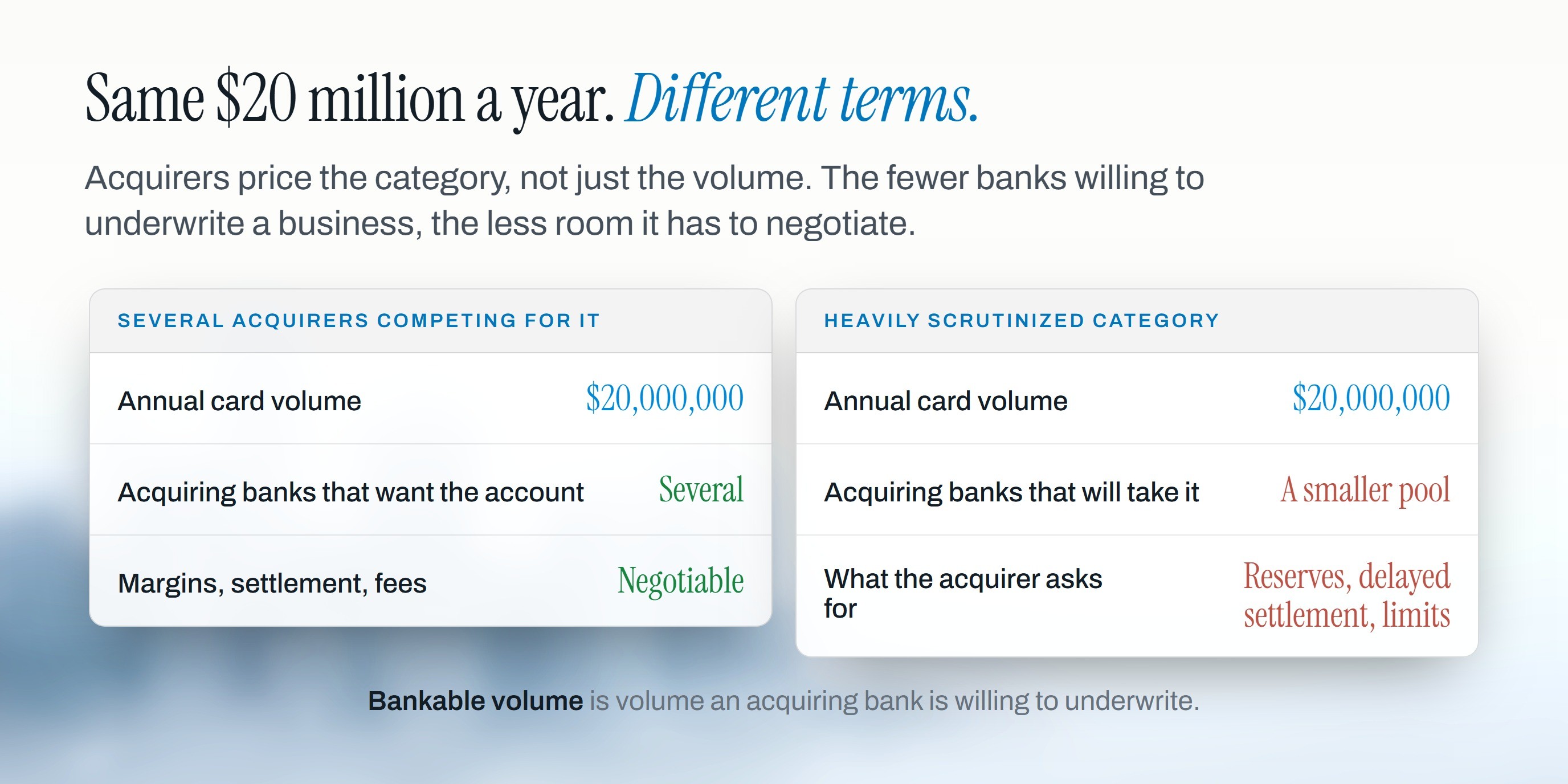
A merchant with several acquiring banks competing for its volume has options. Those options can provide leverage when negotiating processor margins, settlement schedules, contractual provisions and ancillary fees.
A merchant in a heavily scrutinized category may have a much smaller pool of providers. Additional exposure can also lead an acquirer to require higher processing costs, reserves, delayed settlement, processing limits, additional documentation or more frequent account reviews.
This is why comparing two merchants’ headline processing rates without understanding their industries can be misleading. Processing $20 million annually doesn’t necessarily make two accounts equally attractive to an acquirer.
Volume gets attention. Bankable volume gets leverage.
You can’t negotiate away your industry. You can improve the account.
A travel company cannot eliminate the fact that customers pay before they travel. A subscription company cannot eliminate recurring billing while remaining a subscription company.
What these businesses can improve is the quality of the account presented to an underwriter.
Consistent financial performance and adequate liquidity can demonstrate the ability to meet refund and chargeback obligations. Strong fraud controls and low dispute levels provide evidence about transaction quality. Clear billing descriptors, cancellation procedures and responsive customer service can reduce avoidable disputes.
A clean processing history becomes your greatest asset. Stable volume and predictable dispute performance give prospective providers more evidence with which to evaluate the merchant.
Merchants should also confirm that the MCC assigned by their acquirer accurately represents their principal business activity, particularly when the business model has changed or the company operates several distinct lines of business. MCC selection isn’t intended to be a way around underwriting requirements.
The Compaytence takeaway
Your MCC doesn’t determine your destiny with a processor, but it helps establish the context in which your account is evaluated.
For merchants operating in categories that receive greater scrutiny, payments optimization requires more than negotiating a few basis points from the processing rate. Chargeback performance, fulfillment exposure, financial strength, fraud controls and access to alternative acquiring relationships can all influence the terms available to the business.
And that leads to one of the more useful principles in payments:
The best processing terms tend to follow leverage. Leverage follows options. And options depend, in part, on how comfortable the acquiring market is underwriting your business.
Sources and further reading
International Organization for Standardization (ISO): ISO 18245, Retail financial services — Merchant category codes.
Visa: Visa Core Rules and Visa Product and Service Rules, including merchant classification, acceptance and acquiring requirements.
Mastercard: Mastercard Rules and Transaction Processing Rules, including merchant-category, registration and acquiring requirements.
Processor and acquirer policies: Individual providers maintain their own prohibited, restricted and elevated-risk business policies in addition to card-network requirements. Availability and underwriting treatment therefore vary by provider.
The Compaytence Brief covers the infrastructure, economics and strategy behind payments and banking.